
Sound System for a hospital, medical centre or polyclinic
A hospital sound system covers a wide variety of spaces. The design varies depending on their size and whether the system should be part of a shared building or campus-wide setup, or serve only a single location – such as a doctor's surgery and its waiting room.
What spaces are typically covered?
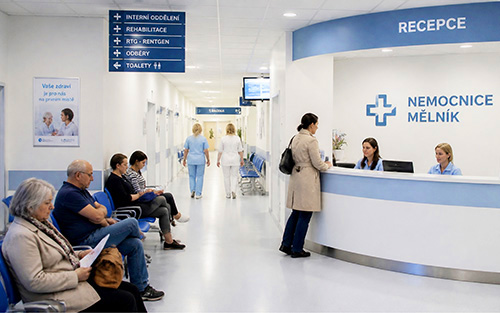
Let's start at the entrance to the healthcare facility. At the reception desk or gatehouse, an intercom helps with communication through a screen or partition. In corridors and public areas, a shared sound system handles operational announcements. Surgeries – particularly private practices not connected to the hospital system – often have their own local sound setup. Likewise, operating theatre staff can use a standalone system so they can choose music directly on the spot.
Sound system for the gatehouse, reception, admissions and emergency admissions
Partition desks tend to be busy, and glass often separates staff from visitors. To ensure both sides can hear each other clearly without raising their voices, a partition intercom WA 220RC is the right choice. One unit sits on the staff side, the other faces the patient or visitor, so communication works in both directions.
You will appreciate it at the gatehouse when directing visitors, at reception when handling enquiries, and at admissions where quick, clear communication is essential. At emergency admissions, it can help staff communicate through a separate partition even when several people are waiting in front of it.
During installation, it is important to position the microphone and speaker on both sides so that the voice is clearly audible without causing feedback. After that, it is simply a matter of setting the right volume for both staff and visitors. The intercom handles conversation at the partition; announcements to the entire waiting room or corridor are best handled by a separate sound system. More about partition sound systems
Sound system for surgeries and their waiting rooms
Each specialist surgery can have its own local sound system, independent of the music playing in the rest of the hospital. In the waiting room, you can play a quiet musical background that makes waiting more pleasant without disturbing conversations or examinations taking place behind closed doors.
For a smaller setup, a PA controller JPA 3035 paired with ceiling speakers RPT 110 works well, or alternatively wall-mount speaker systems ARS 350, or SP 642 and the smaller SP 442 depending on the space available. Speaker placement matters more than high volume. It is better to cover the waiting room evenly with several well-positioned speakers than to play music loudly from a single point. Thanks to its own setup, each surgery can choose its music and volume to suit its own workflow without interfering with the sound system in the neighbouring practice.
The waiting room sound system can also be used to call patients. A desk microphone PA 580 can be connected to the JPA 3035 controller, allowing a nurse to announce the next patient or share a brief operational message. In a large emergency waiting room in particular, this saves repeated trips out of the surgery and calling across the room. If announcements are to be heard only in the waiting room, this needs to be taken into account at the design stage. More about surgery and waiting room sound systems
Sound system for operating rooms
Operating rooms have different needs from offices. Staff can choose and control music directly from their mobile phone – streaming an internet radio station or Spotify, and adjusting or muting it as the situation requires. For a smaller setup, an amplifier JPM 2022WI with two ceiling speakers RP 110 is a practical solution. For larger spaces requiring more speakers, an amplifier JPM 2032WB and ceiling speakers RP 123 are the right choice. The specific configuration and placement must be adapted to the theatre's workflow and the installation requirements of the equipment in that space. We make sure amplifiers remain out of sight.
Sound system for staff areas, doctors' offices and nurses' stations
A sound system does not have to serve patients alone. In a doctors' office or at a nurses' station, quiet background music can make work more pleasant, while operational announcements help pass information to staff without having to walk from room to room. Volume in these spaces should be comfortable and easy to adjust so that sound does not interfere with concentration or conversation.
If the staff area is to be part of the hospital's shared sound system, Dexon IP Audio technology is a natural fit. Audio is distributed over the data network to selected parts of the building, where JPM xxxxIP series amplifiers drive ceiling speakers RPT 110, or wall-mount speaker systems ARS 350. Zone division allows music or operational messages to be sent exactly where they are needed, rather than playing the same content everywhere.
Office and workplace sound systems may serve as useful inspiration.
Sound system for corridors and other public areas
In corridors and public parts of a hospital, intelligibility is the priority. The sound system here serves operational announcements and visitor navigation. Speakers should be distributed continuously along the corridor route so that announcements are clearly audible further from reception, but never unnecessarily loud at any point.
For larger buildings, Dexon IP Audio is a good fit, allowing spaces to be divided into zones and messages to be sent only to the required floor or section of the campus. JPM xxxxIP series amplifiers can be paired with ceiling speakers RPT 110, wall-mount speakers ARS 350, or speaker systems SP 442 and SP 642. The choice depends primarily on the ceiling type, mounting options, and the character of the space.
If the sound system is also required to handle evacuation announcements, a standard IP Audio system cannot automatically be assumed to suffice. The requirements for an emergency voice alarm are defined by the fire safety design of the building; the appropriate system, its monitoring, power supply, and speakers are all designed accordingly. For routine operational announcements, a zoned sound system is practical, but the safety function must be resolved in line with the specific requirements of the hospital in question.
Do you want to accurate this set or to make a price offer?